
From foundational principles to the metrics that matter — why experiential marketing overtook digital advertising this year, and what a B2B decision-maker needs to know to stay ahead.
In 2026, one thing became clear: experiential marketing stopped being a secondary budget line and became the center of brand strategy. Global investment reached USD 128.35 billion in 2024, and this year it captures 38% of total marketing services industry spend — surpassing digital advertising (35%) for the first time (Revenue Memo, 2026).
But behind that growth lies a contradiction worth naming: 95% of B2B teams say proving event ROI is their top priority, yet 38% still can't do it (Bizzabo, 2026).
This article is for both audiences who need to understand this quickly: the one still searching "what is experiential marketing" and the one already investing millions but wondering how to measure it well.
What is experiential marketing?
Experiential marketing — also called live marketing, event marketing, or brand experience marketing — is the strategy that replaces one-way communication (the ad people see) with two-way interaction (the experience people live).
It's not advertising about a product. It's the product turned into tangible experience, where the consumer or B2B buyer actively participates, tests, customizes, or engages with the brand.
A more operational definition: experiential marketing is any activation that generates measurable emotional memory — because unlike traditional advertising, its effectiveness is measured not in impressions, but in what the audience remembers 90 days later.
One data point that says it all: according to Forbes, 50% of people with a positive brand experience actively share it (Antavo, 2022). That's organic reach no CPM buys.
The 5 C's of experiential marketing
The 5 C's are the classic framework for designing any experiential activation. They aren't academic invention — they're the questions any brand team should be able to answer before approving budget:
- Content — What story does the experience tell? Content isn't copy; it's the full narrative.
- Context — Where and when does it happen? The same asset changes meaning whether it lives at Art Basel or at an industry trade show in Medellín.
- Community — Who exactly is it for? An activation that tries to speak to everyone speaks to no one.
- Customization — How does it adapt to each participant? Personalization separates an experience from a mass event.
- Connection — What does the participant take with them after leaving? If there's no post-event continuity, there was a show, but not marketing.
Las 4 E’s del marketing experiencial
If the 5 C's are planning, the 4 E's are execution. They're the model that defines what makes an experience work:
- Experience — the activation itself, what the participant lives.
- Exchange — what the participant gives and receives (information, product, emotion, connection).
- Everyplace — the experience isn't only physical: it extends to digital, social, and word-of-mouth.
- Evangelism — participants become ambassadors who multiply organic reach.
The 4 E's replaced Kotler's classic 4 P's (Product, Price, Place, Promotion) in experiential context — because the P's describe a transaction, and the E's describe a relationship. transacción, y las E’s describen una relación.
Iconic experiential marketing examples
Three cases that already belong to the canon — and why they worked:
Nike House of Innovation. Not a store — a cultural lab. The consumer touches materials, customizes products, tests athletic experiences, and moves through the space as if entering a culture, not an inventory. Technology supports; emotion leads.
Red Bull Stratos. Felix Baumgartner's 2012 stratosphere jump was experiential marketing elevated to mythic level. Red Bull didn't pay for that content — it created the content by making it happen. Over 8 million people watched live on YouTube. ROI impossible to calculate with traditional metrics.
Coca-Cola «Share a Coke». The campaign that personalized bottles with names lifted sales 2% globally and revived a brand that had been declining for 10 years in mature markets. The experience: seeing your name on the bottle. Simple, scalable, massive.
Barbie Movie Pop-Ups (2023). The experiential activation that accompanied the film launch generated over one billion organic social media impressions without spending a single additional dollar on paid media.
In B2B the pattern differs but the logic is the same. Technology booths at industry congresses — like the one we designed for ASP at the 2026 Ibero-American Sterilization Congress — work when they stop being exhibition and become active commercial assets. That difference is measured in closed meetings, not visitor traffic.
The data every B2B CMO should have on the table in 2026
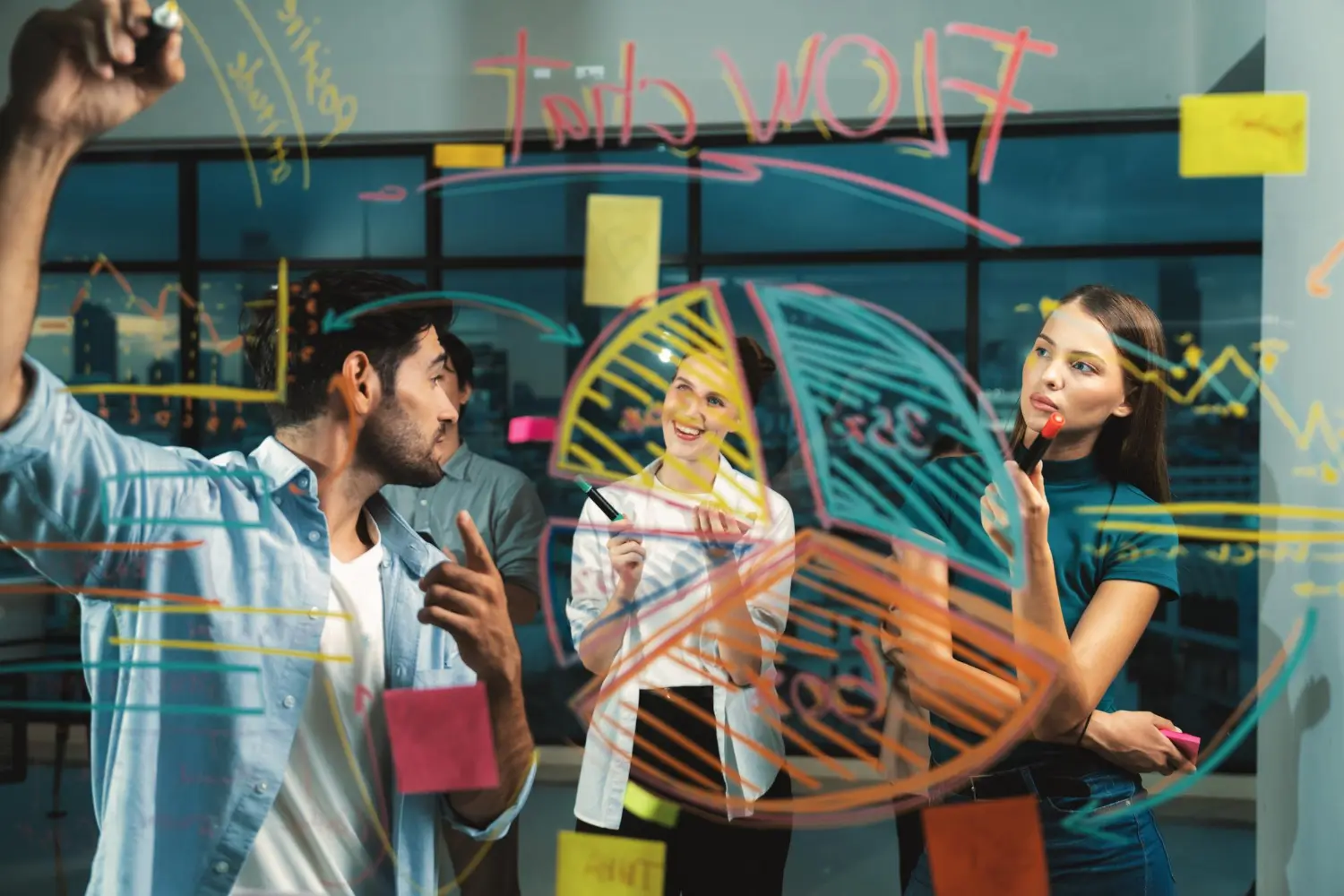
Up to here, educational content. From here on, what matters to whoever signs the checks.
The market and the spend
- The global experiential marketing market reached USD 55.53 billion in 2026 and will hit USD 71.22 billion by 2035, growing at a 3.16% CAGR (Revenue Memo, 2026).
- B2B companies invested USD 38 billion in experiential marketing in the last documented year — and the curve keeps climbing.
- 78% of B2B marketers already allocate budget to this channel (Content Marketing Institute / Blackpool Digital, 2026).
- 47% of in-person event marketers say live has the highest ROI of any marketing channel.
The real ROI, with numbers
- 86% of B2B organizations report positive ROI from their hybrid events within the first 7 months (ON24, 2025).
- Average cost per lead at B2B trade shows: USD 112, vs USD 259 per lead generated through cold sales calls (Exhibit Surveys, 2025). Experiential costs less than half per qualified lead.
- 64% of B2B event attendees say immersive experiences are the most important part of an event — not the agenda or the keynote speaker.
The problem that still isn't solved
- 95% of B2B teams prioritize measuring experiential ROI.
- 38% still can't do it (Bizzabo, 2026).
- The gap between priority and capability is exactly the space where budget justification is lost in front of the CFO.
The metrics a B2B CMO should be measuring in 2026
If your team still reports events in "visitors" or "impressions," they're speaking a 2015 language. The metrics that justify investment today are different:
Acquisition metrics:
- Cost per qualified lead (CPQL) at the event.
- Attendee → scheduled meeting conversion rate.
- Meeting → opened opportunity conversion rate.
Brand impact metrics:
- Brand recall lift at 30, 60, and 90 days (measurable via pre/post surveys).
- Purchase intent lift among attendees vs. unexposed control.
- Post-experience Net Promoter Score (minimum acceptable threshold: 50+ in B2B).
Organic amplification metrics:
- Organic social impressions generated by participants.
- Mentions and UGC during and after the event.
- Equivalent paid media cost of organic coverage generated.
Pipeline metrics:
- Event-attributable pipeline (sum of opened opportunities).
- Close time vs. leads from other channels.
- Customer Lifetime Value (CLV) of clients acquired via experiential.
A company measuring these variables can defend an experiential budget before any finance committee. One that doesn't is gambling — and the CFO knows it.
Why experiential marketing wins in B2B
In B2C, experiential marketing is emotion. In B2B, it's purchase risk reduction. reducción de riesgo de compra.
When a B2B buyer has to invest USD 50,000, 500,000, or 5 million in a decision, what they need most isn't information — they have it. What they need is demonstrable trust in the provider. And trust isn't built with a capabilities PDF. It's built when the buyer experiences how the company executes, how it treats its teams, how it solves problems in real time.
That's why a well-designed booth at an industry congress sells more than five outbound emails. That's why a well-executed incentive trip retains clients better than any digital loyalty program. That's why a well-crafted cultural activation positions a global brand in LATAM better than three months of LinkedIn paid media.
Experiential marketing in B2B isn't decoration. It's the most efficient way to transfer trust from brand to buyer.
What comes next
The next chapter of experiential marketing is its integration with technology — personalizing AI, AR/VR for immersion, real-time sensors and data, hybrid platforms scaling live to digital reach. We'll cover that in our next Penta Insights edition.
In the meantime, if your organization is building or auditing its experiential strategy for 2026, it's worth having a conversation.
At Penta Marketing we design and execute brand experiences for global B2B companies like Mastercard, Bayer, Pepsi, Mattel, and PMI — activations, incentive programs, corporate events, and cultural experiences across the U.S., Central America, the Caribbean, and the Andean region.
Let's talk at PentaMarketingAgency.com.
Media Contact:
Sebastián Velandia Marín, Head of Communications smarin@pentapro.com
About Penta Experiential Marketing
Penta Experiential Marketing is a Miami-based multicultural agency specializing in experiential marketing. The firm develops world-class events, activations, DMC services, and incentive programs across the Americas. Penta partners with multinational brands to penetrate new markets, engage diverse audiences, and execute with cultural precision and measurable business impact. https://pentamarketingagency.com/
About Camilo Caicedo
Camilo Caicedo is the Founder and CEO of Penta Experiential Marketing. Originally from Colombia, Caicedo is the former President of the American Marketing Association and a leading voice in multicultural growth and cross-market collaboration. Recognized as a Latin ambassador within the regional marketing industry, he built Penta with a clear vision: connecting cultures, opening new markets, and helping multinational brands expand with confidence and cultural intelligence. https://camilocaicedo.com/
About Worldwide Partners, Inc.
Worldwide Partners, Inc. (WPI) is one of the world’s most collaborative networks of independent agencies, driving growth through access, flexibility, and strategic partnership. With over 90 agencies in 50+ countries and expertise across 90 industries, WPI serves as a global hub that integrates diverse talent and knowledge to redefine brand and agency growth. https://www.worldwidepartners.com/